Bryan Grieve & Grant Piraine
Jun 29, 2026
Utility Locates Inside Buildings - A Risk Management Framework for Ground Disturbance
When most people think about utility locating inside buildings, they think about scanning concrete before drilling, coring, cutting, or demolition begins. While concrete scanning is an important part of many projects, it is only one component of a much larger investigation. Understanding the difference between scanning a concrete slab and investigating the buried utility infrastructure beneath it is critical to reducing risk and preventing serious incidents.
One of the most common misconceptions in the industry is that concrete scanning and private utility locating are the same service. They are not. A concrete investigation is typically focused on identifying hazards embedded within the slab, such as post tension cables, reinforcing steel, embedded conduits, and structural elements. A subsurface utility investigation focuses on buried electrical systems, communications infrastructure, water services, sewer systems, underground duct structures, and other buried utility infrastructure beneath the concrete. Depending on the planned work activity, one or both investigations may be required.
This distinction becomes particularly important when drilling extends beyond the slab. A contractor cutting a shallow trench in a concrete floor faces a very different risk than one installing geotechnical boreholes, foundation piers, or deep anchors. While the concrete may be properly scanned, buried utility infrastructure beneath the slab can still present significant hazards if it is not investigated.
Unlike exterior excavation, interior ground disturbance rarely allows for progressive verification using vacuum excavation or hand digging. Once a slab is cored or drilled, the disturbance has already occurred. If assumptions about buried utility infrastructure are wrong, there may be little opportunity to prevent damage. Electrical arc flash incidents, flooding, communications outages, operational shutdowns, structural damage, and serious worker injuries have all occurred because the investigation did not extend beyond the concrete itself.
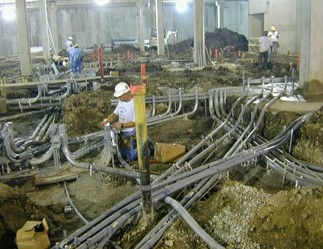
The challenge becomes even greater in older commercial, industrial, institutional, and healthcare facilities where decades of additions, renovations, undocumented modifications, and changing ownership have created complex infrastructure environments. Utility services that originally entered through an exterior wall may now continue beneath interior slabs because the building was expanded around them. Electrical systems may pass through underground duct structures to locked electrical rooms before continuing to other portions of a facility. These conditions are often not apparent from available drawings or public utility locates.
Effective interior investigations therefore require more than simply selecting a scanning technology. They begin with understanding the planned work activity and determining the appropriate scope of investigation. Depending on the project, that investigation may include records review, site reconnaissance, utility service entry points, electrical rooms, utility main disconnects, electromagnetic locating, Ground Penetrating Radar (GPR), sewer cameras, push rodders, radiography, and consultation with facility personnel or subject matter experts. The objective is not to eliminate all uncertainty, but to reduce it to a level where informed and defensible decisions can be made before irreversible disturbance begins.
The North American Private Utility Association (NAPUA) refers to this investigative approach as Tailgate SUE. While not formal Subsurface Utility Engineering (SUE), it applies many of the same investigative principles immediately before drilling, coring, cutting, demolition, or rehabilitation begins. Rather than focusing only on the immediate work area, Tailgate SUE encourages professionals to understand how utility infrastructure functions throughout the building, identify investigation limitations, and implement additional controls where necessary.
The paper also explores a number of actual case studies involving interior electrical strikes, foundation repair projects, and high-occupancy commercial facilities where assumptions about buried utility infrastructure created significant operational and life safety risks. These examples demonstrate that successful risk management is not achieved by relying on a single technology, but by selecting the appropriate investigation based on the planned work activity, the disturbance depth, and the potential consequences of a strike.
As interior construction and rehabilitation projects continue to increase across North America, the need for consistent guidance has never been greater. To help address this gap, the North American Private Utility Association (NAPUA) has developed the Interior Locate Best Practice together with companion Interior Locate Guideline. These documents establish a practical framework for determining what constitutes a reasonable interior utility investigation, recognizing that concrete investigations and subsurface utility investigations are not always the same and that the scope of work should be driven by the planned work activity, disturbance depth, and associated level of risk. We invite you to download the complete white paper to learn more about NAPUA's approach to managing interior ground disturbance risk.
Download the complete white paper:
.